Brackish Water Transition Feeding: Automate Without Failure
By Arjun Mehta • 27th Feb
Understanding the Challenge: Why Transition Feeding Matters in Brackish Setups
Brackish water transition feeding isn't simply a matter of dumping pellets into a tank while you gradually raise salinity. It's a three-variable optimization problem: feeding volume, feeding schedule, and salinity trajectory must move in concert, or your water quality collapses and your fish suffer.[1] Most aquarists don't account for the compounding stressors. A fish adjusting to higher salinity undergoes osmoregulatory strain (its kidneys and gills are working overtime to maintain internal salt balance).[1] Simultaneously, if you're overfeeding during this transition, uneaten food decays, ammonia spikes, and your biological filter becomes overwhelmed trying to handle both the added bioload and the salt-induced bacterial lag. The nitrogen cycle doesn't adapt instantly to rising salinity.[1] For the biology behind how feeding schedules impact water quality during salinity changes, see our science-backed fish feeding guide.
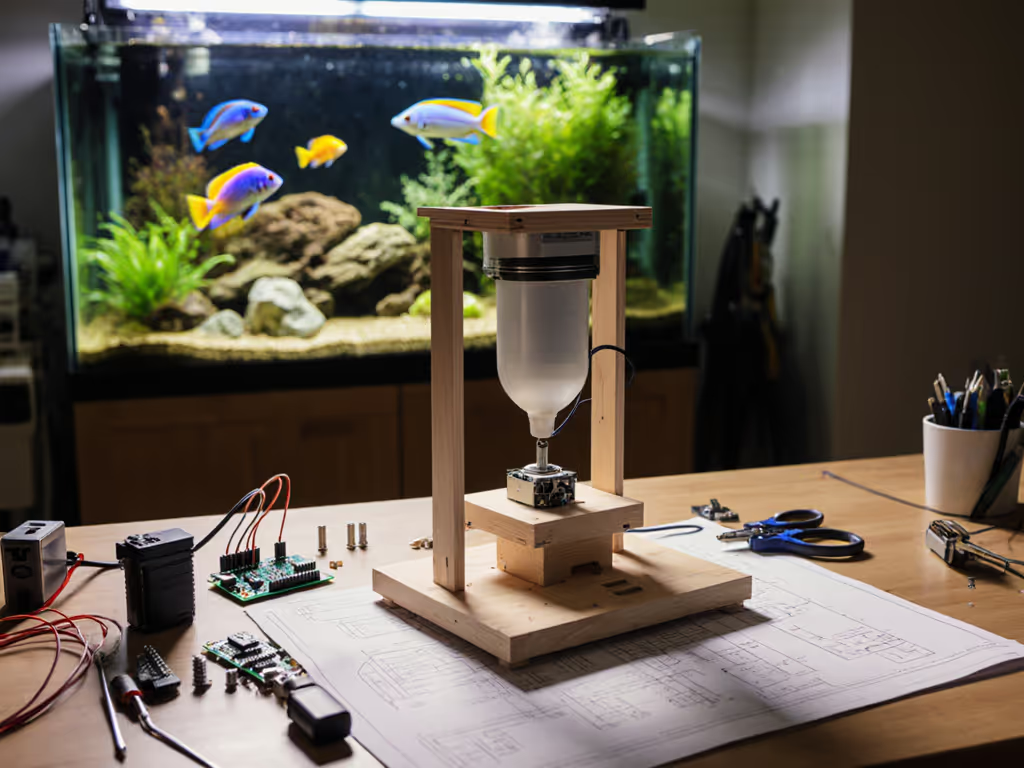
Let's quantify that: I once relied on a weekend feeder that malfunctioned during a conversion to brackish conditions. It released a full five days' ration in one go. Ammonia hit 2 ppm within 18 hours. My planted tank crashed. I rebuilt that system with redundant timers, clog detection sensors, and programmed micro-dosing (feeding smaller portions more frequently instead of large dumps). Watching the tank stabilize, then seeing my shrimp graze naturally again, taught me a hard lesson: automation without fail-safes is worse than no automation at all. For proven backup strategies that prevent single-point failures, see our vacation feeder redundancy guide.
FAQ: Designing Your Transition Feeding Protocol
What feeding adjustments do I need to make when transitioning to brackish?
During acclimation phases, brackish fish experience reduced appetite as an acute stress response.[1][2] This is normal. The mistake is compensating by increasing portion size. Instead, reduce feeding volume by 20-30% during the first two weeks of salinity increase (target no more than 0.002 SG increase per week).[1][2] Then, once fish are acclimated to your target salinity, pivot to a metric-driven feeding schedule that tracks species-specific appetite recovery.
Brackish fish are predominantly meaty eaters (think puffers, mudskippers, archerfish).[1] But during transition, simplify: high-quality sinking pellets only, once daily, in quantities your fish will consume within 3-5 minutes.[1] No bloodworms or frozen shrimp until they're stable. The reason is metabolic clarity: if water quality dips, you'll know it's not because of uneaten rotting protein fouling the substrate.
How do I automate feeding during a salinity transition without crashing my tank?
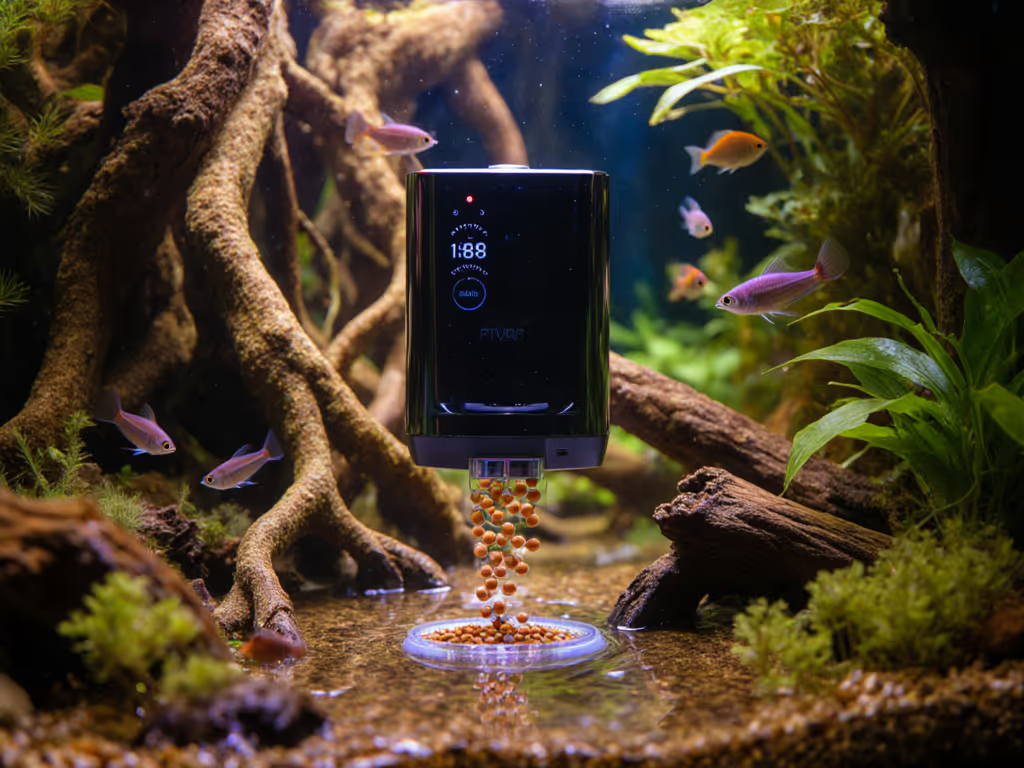
This is where precision beats hope. A metric-forward approach uses redundant timers and portion-controlled feeders. Here's the schematic:
- Primary feeder: Automated unit set to dispense micro-portions (think 2-3 mm pellet pile) twice daily during transition weeks 1-2, then advance to three smaller daily portions once SG stabilizes.
- Secondary fail-safe: A mechanical timer feeding once daily by hand, or a secondary electric feeder as backup. If your primary feeder jams, you catch it before starvation or accumulation crashes your cycle.
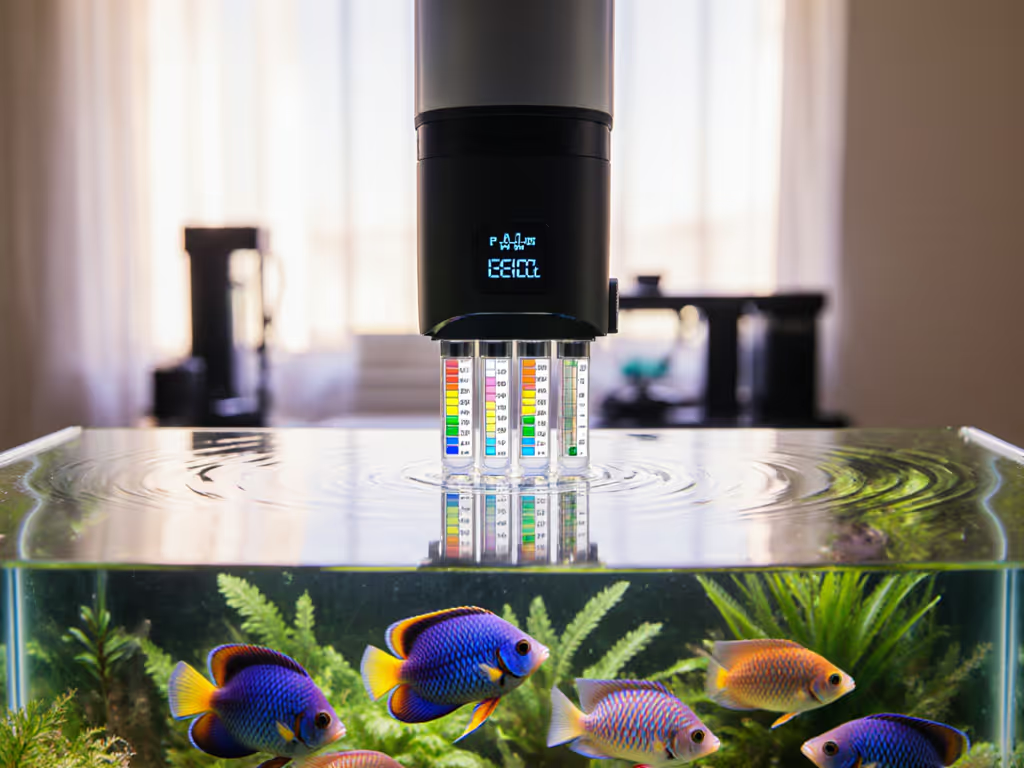
- Monitoring integration: A simple sensor (optical or magnetic) on the feeder hopper alerts you if it hasn't triggered, or if a clog develops. Many IoT-capable feeders log portion size and skip rate to cloud dashboards. If you're building a responsive setup, follow our feeder controller integration guide to connect sensors and automate actions safely.
Why redundancy? Automation is only trustworthy when it can fail safely. Feed like a system, never a hopeful guess. A single feeder is a single point of failure; during a phase change as stressful as salinity increase, that's too much risk.
What metrics should I track during brackish transition feeding?
Data wins. Track these weekly:
- Portion consumed (% of dispensed amount): Log how much pellet matter remains after 5 minutes. If consumption drops below 70%, your SG is climbing too fast or water quality is degrading.
- Water parameters: Ammonia (must stay <0.25 ppm), nitrite (0 ppm), nitrate (target <20 ppm during transition). Spikes correlate directly to overfeeding or microbial lag.
- Fish appearance: Dorsal fin condition, coloration saturation, belly roundness. A spreadsheet entry every 3-4 days is sufficient; visual trend spotting catches decline before crisis.
- SG and pH drift: Salinity should creep up exactly 0.002 SG per week; faster increases stress osmoregulation and suppress appetite. pH should remain within species range (typically 7.8-8.4 for brackish stocks).[1]
A dashboard pull once per week (even a hand-written log) turns feeding from guesswork into feedback-driven iteration.
Can I use standard aquarium auto-feeders, or do I need brackish-specific equipment?
Standard freshwater auto-feeders work fine mechanically, but you must adjust your expectations. For hardware that resists salinity creep and corrosion, see our brackish tank feeder picks. Pellet expansion rate changes slightly in higher salinity, so a feeder calibrated for freshwater may overshoot or undershoot portion size by 5-10%.[1] This isn't catastrophic, but it's noise in your data.
If you're already invested in a feeder, recalibrate: dispense a test portion into a cup of your transition salinity water, measure wet weight after 2 minutes, and note the expansion ratio. Then back-calculate your dispense setting. Most quality feeders let you adjust hopper gate duration or portion weight in firmware.
Honestly, the bigger win is pairing any feeder with a simple observation protocol. Spend 2 minutes at feeding time watching fish behavior. Do they race to food? Do they spit it out? Are fins clamped? These signals matter more than the feeder's feature set.
What about water changes during transition (do they affect feeding schedules)?
Absolutely. Water changes are your primary tool for managing ammonia during feeding transitions.[1][2] Here's the risk model:
- Weeks 1-2 (high-stress acclimation): Perform 25% water changes twice weekly using pre-mixed brackish water (same SG as your tank).[1][2] This dilutes ammonia without disrupting your rising salinity gradient. If you're micro-dosing feed (multiple small portions), these twice-weekly changes prevent bioload accumulation.
- Weeks 3-4 (recovery phase): Drop to one 25% change per week, then transition to your standard maintenance schedule (usually weekly 20-30% for brackish).[1][2]
Water change day is also verification day. Measure SG before and after the change; if your salinity isn't rising by ~0.002 per week, your salt mix concentration is off. Adjust the salt-to-water ratio for the next batch.
How do I know when to resume full feeding and varied diet?
Wait until three markers align:
- SG at target (e.g., 1.005-1.010 for true brackish species like puffers).[1]
- Fish appetite fully recovered (100% consumption of portions within 3-5 minutes for 7 consecutive days).
- Water parameters stable (ammonia <0.1 ppm, nitrite 0 ppm, nitrate <15 ppm for 2+ weeks).
Once these lock, you can introduce frozen Mysis shrimp, bloodworms, and vegetable matter (for mollies and scats).[1] But continue logging. Dietary variety increases bioload; your ammonia buffer will shrink, and you'll need to either increase water change frequency or reduce portion sizes slightly.
Summary and Final Verdict
Brackish water transition feeding succeeds when automation is paired with redundancy and data discipline. A single auto-feeder, no backup, and no tracking is theater masquerading as automation. An overcomplicated system with five sensors and no clear decision-making is theater too.
The sweet spot: one reliable feeder with a mechanical backup, a simple logging system (spreadsheet or app), and a weekly review ritual. Measure consumption, water chemistry, and fish behavior. Adjust portion size and frequency based on what the data tells you, not on assumptions about what your fish "should" eat. The redundancy protects your system when the feeder fails; the data protects your fish when it doesn't.
Years of practice taught me that the most sophisticated setup is the one you actually maintain. Pick a protocol you'll stick to for four weeks straight, automate the mechanical parts, and stay obsessively attentive to the measurable signals. Precision dosing with layered fail-safes doesn't just prevent disasters (it frees you to trust your automation because you've earned that trust through evidence, not hope).
Related Articles