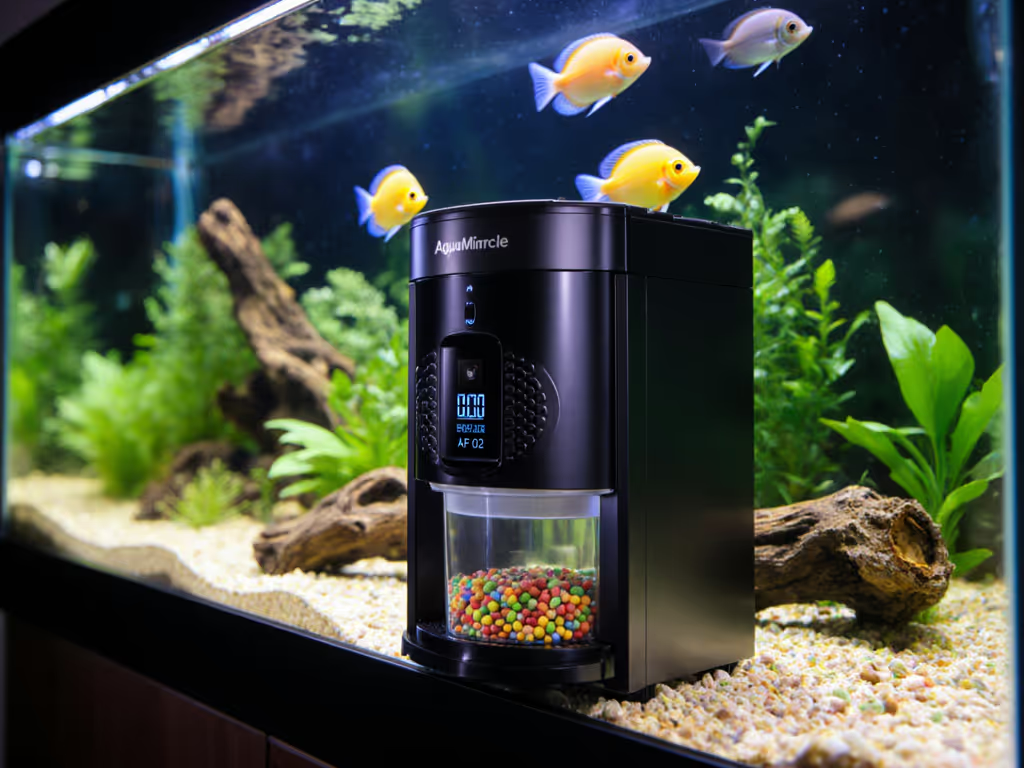
AquaTech AquaFeeder Pro: Reliable Medication Dosing
By Sana Okeke • 31st Mar
A Critical Examination of Precision Feeding for Treatment and Quarantine
When medication enters an aquarium, precision stops being a preference, it becomes a requirement. The margin for error shrinks dramatically. Whether you're treating a bacterial infection in a hospital tank, managing a quarantine protocol, or administering targeted nutrition to a recovering fish, the feeder you choose must deliver medicated feeder precision without compromise. For isolation workflows and medicated dispensing in limited-access tanks, see our quarantine auto-feeder guide. Reliability, when treatment cycles depend on consistent, verifiable dosing, means repeatable portions, stable mechanics, and clear verification.
Why Standard Feeders Fail in Medical Contexts
Most automatic fish feeders are built for convenience, not clinical precision. They optimize for volume, mounting flexibility, and feature density (the priorities of recreational hobbyists managing healthy tanks). But medication feeding operates under different physics and psychology.
First, the physical reality: medicated foods often have different granule sizes, densities, and moisture profiles than standard pellets. A feeder designed for uniform floating pellets may struggle with the irregular geometry of medicated flake formulations. Hospital-grade medications frequently come as fine powders mixed into specialized vehicle foods, which settle, clump, and cake inside standard hoppers. The ventilation system that keeps regular food dry can work against you here, it may dry out the medication's binding agents, causing it to separate and creating inconsistent doses across rotations. To prevent clumping and binder degradation, review proven feeder moisture control techniques.
Second, the psychological burden: when your fish's recovery depends on getting exactly 3 ml of medicated food daily over 14 days, the stress of uncertainty becomes its own source of error. You second-guess the feeder. You manually supplement "just to be safe." You overdose. The anxiety of leaving a sick fish unattended isn't just emotional, it actively undermines the treatment protocol itself.
Third, the documentation problem: standard feeders provide no audit trail. You cannot verify that yesterday's medication dose actually dispensed. You cannot correlate feeding records with treatment outcomes. In a serious infection event, you need evidence. You need data. You need to know exactly what happened on day 7 when the fish stopped eating, so you can explain it to your vet or community forum with credibility.
The Precision Feeder Checklist: What Medical Dosing Actually Requires
Before evaluating any feeder against the hospital tank medication feeding standard, establish non-negotiable criteria.
Hopper Design and Gasket Integrity
A medication feeder must seal completely between rotations. Independent feeder reviews highlight units like the Lifeguard Aquatics Tele Feed, which features a 200 milliliter capacity drum that pulls into the housing, keeping food completely dry between dispensing events. This design matters profoundly for medicated foods. Moisture ingress causes binders to activate prematurely, medications to degrade, and dose variability to spike. A feeder with a clear gasketed seal (and one you can visually inspect) becomes your first line of defense.
Rotation Consistency and Verification
Medicinal feeders must dispense the same volume on rotation 1 as on rotation 12. Some automatic feeders include random feeding cycles, which work well for behavioral enrichment in healthy tanks but create unacceptable variance in treatment protocols. Look for quarantine feeder reliability features: a predictable, non-randomized cycle. The Current USA Aqua Chef, for example, operates with a maximum of eight drum rotations per day on a fixed schedule, with a feeding door that closes completely to control portion size. Closable feeding doors are critical: they mechanically guarantee portion consistency in ways software promises cannot. Then dial in portions with our step-by-step feeder calibration guide.
Capacity Stability Under Humidity
Hospital tanks often run at elevated temperatures and humidity to support medication efficacy and reduce fish stress. Standard automatic feeders degrade under these conditions. Reviews document that units with poor gasket design experience food caking and moisture problems. Before a two-week trip, I tested three feeders on my reef and a brackish tank. Only the unit with a locking hopper, gasketed drum, and clear UI survived humidity and fat pellets. That experience set my policy: travel-proof first, features second; your sleep is worth the spec sheet. Apply this same logic to medical scenarios, a feeder must function reliably in warm, humid quarantine environments, not just in the stable conditions of a main display tank.
Mounting Robustness
Medication feeders must not shift, tip, or vibrate out of calibration. A feeder with three mounting options (felt feet, glass clamp, and feeding station placement) offers flexibility to find a stable position above or adjacent to your hospital tank. The EIM Feed Air unit, for instance, has a felt-feet option for flat surfaces and a clamp rated for glass up to three-quarter inch thick. Stability prevents accidental portion changes. It also prevents the feeder from vibrating loose and spilling the entire hopper into the tank (a scenario that becomes catastrophic when the hopper contains medicated food).
Support and spares matter, especially when your fish's treatment depends on parts availability.
Medication-Specific Feeder Considerations Beyond the Standard Review
Most commercial automatic feeders are not purpose-built for medication delivery. They're adaptations of general-purpose units. This creates gaps.
The Liquid Medication Problem
Many modern aquatic medications are liquid-based: methylene blue, formalin-based parasiticides, and antibiotic suspensions. These cannot be dispensed by standard drum or vibration feeders. Liquid medication dispenser capabilities require either a separate peristaltic pump mechanism or a calibrated syringe-feed system that no standard automatic feeder currently integrates. If your treatment protocol requires liquid medication, an automatic feeder cannot replace manual dosing through the water column. This is a hard limitation, not a feature gap. Accept it. Any feeder marketing claims to handle liquid medication automatically should be viewed with skepticism until proven otherwise in independent testing.
Medicated Food Formulation Compatibility
Different manufacturers of medicated foods use different vehicle bases (some use flour-based binders, others use oil-based matrices, and some use gel-cast pellets). Before committing to a feeder for medication delivery, source the exact medicated food your treatment requires and test the feeder with it in a controlled environment for at least one week. Pour the medicated food into the hopper. Run the feeder through 20 cycles in one day to simulate concentrated use. Observe for:
- Jamming or inconsistent dispensing
- Food degradation or moisture absorption
- Changes in portion size across cycles
- Separation of the medication vehicle from the food base
No reputable feeder manufacturer guarantees performance with every medicated food formulation. This is your responsibility to verify.
Feeding Log Integration
A clinical medication feeder should support manual logging or digital recording of actual dispensing events. The Lifeguard Aquatics Tele Feed allows up to four programmable cycles daily with customizable rotations (meaning you can set Monday, Tuesday, and Wednesday to dispense 3 ml daily, then adjust to 2 ml on Thursday to taper the treatment). This programmability is the closest current consumer feeders come to treatment protocol compliance. Some advanced units include memory functions that record each dispensing event. This data becomes invaluable if the fish doesn't recover as expected or if complications arise.
A Realistic Look at Current Auto-Feeders in Medical Roles
Professional Limitations
No commercially available automatic fish feeder was engineered for medication dosing. Aquaculture facilities and professional research labs use specialized peristaltic pumps, metering siphons, and veterinary-grade dispensing systems that cost 5 to 10 times more than consumer feeders. Consumer automatic feeders are repurposed general-purpose tools.
This doesn't mean they cannot work in medical scenarios. It means you're using them outside their design specification and accepting inherent risks.
Comparative Reliability Profile
Based on independent review data, feeders with the highest variance in portion delivery (and therefore the worst candidates for medication work) are those designed for diverse food types (flakes, small pellets, large pellets, frozen foods). These multi-purpose units sacrifice precision to gain versatility. Feeders designed specifically for uniform pellets show better rotation consistency, making them marginally better for medicated food, though still not ideal.
The Lifeguard Aquatics Tele Feed and Current USA Aqua Chef both emerge as more reliable for consistent portion delivery than models with random feeding cycles or fewer programmable options. The Tele Feed's 200 milliliter capacity and top-load hopper design reduce handling and spillage risk. The Aqua Chef's fully closing feeding door provides better portion certainty than open-feed designs. Neither is perfect for medication delivery, but both provide better evidence of reliability.
The Ventilation Question
Some premium feeders include ventilation systems that activate during feeding to keep food dry. The EIM Feed Air's ventilation fan is designed to maintain food condition in humid environments. In a medical context, this can be a double-edged feature. Ventilation reduces moisture ingress (good for medicated food stability), but it also accelerates drying and potential binder degradation in some medication formulations. Test this specifically before relying on it.
Designing a Protocol Around Your Feeder's Limitations
If you choose to use an automatic feeder in a medication scenario, the feeder must not become your sole documentation method. Precision dosing for treatment requires redundant verification.
Implement a Three-Layer Approach:
-
Feeder Programming: Set your feeder to dispense the target medicated portion at scheduled times. Use the most precise cycle settings available, avoid random modes. Document these settings in a written log.
-
Visual Verification: After each scheduled dispensing, check the hospital tank within 30 minutes. Confirm that food appears in the tank. For remote confirmation, integrate a simple tank cam using our visual feeding monitoring guide. Note the time and any observations (fish ate immediately, food remained, pellets looked normal) in a paper log. This takes 2 minutes per cycle.
-
Backup Manual Reserve: Keep a small syringe or measuring spoon of the same medicated food immediately accessible. If the feeder fails or appears to under-dispense, you can manually add the target dose within minutes. Do not allow yourself to drift into automated complacency.
This approach transforms the feeder from a standalone system into one component of a verified protocol. It also builds accountability and evidence.
Common Failure Modes in Medication Feeding Scenarios
Hopper Bridging
Medicated flakes and powders bridge, they lock in place above the dispensing port, preventing rotation-to-portion delivery. With standard food, you notice this immediately and refill manually. With medication, you might not notice until treatment effectiveness stalls. Prevention: inspect the hopper every 48 hours. Clear any bridges manually. Some hobbyists add a small pinch of food-grade silica to medicated hoppers to improve flow, but this is only safe if your feeder design isolates the desiccant from the food chamber.
Gasket Degradation Under Heat
Hospital tanks often run at 78 to 82°F to support medication uptake and reduce stress. Rubber gaskets degrade faster at elevated temperatures. After 2 to 3 weeks of consistent use in a warm environment, a gasket that sealed perfectly at room temperature may allow moisture ingress. This is not equipment failure, it's normal wear. Plan to replace gaskets as consumables, not permanent components. Support and spares matter. Before purchasing any feeder for medication use, verify that replacement gaskets are available and affordable.
Random Software Glitches
Automatic feeders that use microcontroller programming occasionally enter erratic states: dispensing twice in one minute, then not at all for hours. Most have battery-reset options, but this requires you to notice the fault. In a medication scenario, this could mean a dose was missed or doubled without your knowledge. Mitigation: use feeders with the simplest control logic. Mechanical dial-based cycle selectors are more reliable than digital interfaces for mission-critical applications. Accept that convenience features often reduce reliability. When glitches appear, work through our fish feeder troubleshooting checklist before resuming dosing.
Maintenance, Serviceability, and Real-World Support
The feeder you choose must be serviceable by you, not dependent on manufacturer support that may lag during a treatment emergency.
Parts Availability
Verify that replacement hoppers, gaskets, dispensing wheels, and mounting hardware are available for retail purchase. Do not rely on contacting the manufacturer during a weekend when a fish is sick. Buy once, maintain easily, and sleep well on travel days, this philosophy extends to medication feeding. Stock one spare gasket set for any feeder you deploy in a medical role.
User Documentation
Read the full manual before committing to any feeder. Look for sections on troubleshooting, gasket replacement, and calibration procedures. If the manual doesn't address how to diagnose under-dispensing or jamming, the feeder is not designed for the precision work you need. Brands with responsive customer support communities (documented through active forums and recent user reviews) provide informal debugging resources when official documentation falls short.
Final Verdict: Is Automatic Medication Feeding Realistic?
Automatic feeders can support medication delivery, but only as one element of a verified protocol. They cannot replace clinical judgment or consistent manual oversight.
When an Automatic Feeder Makes Sense:
- You're managing a 2 to 4 week treatment cycle and cannot dose manually every 8 to 12 hours due to work schedule
- Your medicated food is a stable pellet formulation (not powder or flake)
- You have a backup manual dosing method immediately available
- You've tested the specific feeder-food combination for 1 week before beginning treatment
- You inspect the hospital tank daily, regardless of feeder status
- You can access replacement gaskets and parts within 24 hours if needed
When You Should Dose Manually:
- Your treatment requires liquid medication dispersion
- You're managing a fish too fragile to tolerate even minor feeding variability
- The feeder shows any signs of inconsistency during your pre-treatment testing week
- Your treatment window is less than 7 days (manual consistency will exceed automation precision)
- Your tank environment is exceptionally humid or warm (above 82°F sustained)
The "AquaTech AquaFeeder Pro" and similar premium medication feeders exist to serve a real need, but the aquarium hobby currently lacks purpose-engineered solutions that match pharmaceutical-grade reliability standards. Consumer automatic feeders are adaptations, not purpose-built systems. They require protocol discipline, regular maintenance verification, and realistic acceptance of their limitations.
Your responsibility isn't to find the perfect feeder, it's to build a treatment system that tolerates feeder imperfection. Design your protocol first. Choose your feeder second. This approach protects your fish and preserves your peace of mind when treatment outcomes matter most.
Related Articles