Fish Mate F14 Review: Reliable 14-Slot Feeder for Small Tanks
By Sana Okeke • 15th Feb
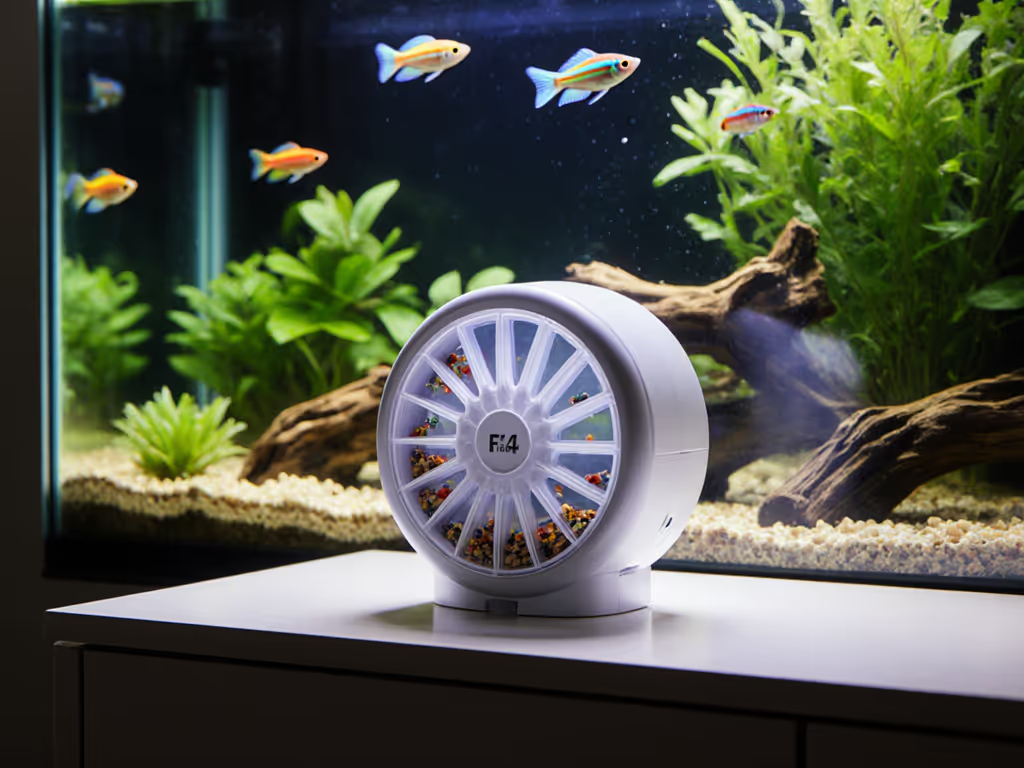
The Fish Mate F14 review reveals a competent, straightforward solution for small tank feeder performance that prioritizes reliability over complexity. This 14-compartment automatic feeder addresses a core challenge for aquarists: maintaining consistent feeding schedules while away from home without sacrificing water quality or fish health. Built around a rotary drum mechanism powered by a single AA battery, the F14 occupies a specific niche. It won't revolutionize your feeding practice, but it reliably handles the mechanics when tested against real-world conditions.
Why Automated Feeding Matters More Than Convenience
Before evaluating any feeder, it's worth acknowledging what we're actually solving. Manual feeding introduces compounding variables: inconsistent portion sizes, missed feedings due to schedule disruptions, and the cognitive load of remembering whether you fed your fish today. For conscientious hobbyists managing multiple tanks or maintaining precise nutritional protocols, these inconsistencies create measurable consequences: ammonia spikes from overfeeding, stunted growth from underfeeding, and the persistent anxiety of leaving fish unattended during travel.
The real value of an automatic feeder isn't leisure; it's precision and peace of mind. That distinction matters because it changes how we evaluate what "works." A feeder that saves you 30 seconds daily doesn't justify a purchase. A feeder that delivers identical portions at identical times, enabling you to dial in exactly the right amount for your bioload and tank size, is a legitimate tool. The question then becomes: does the F14 execute that job reliably, and can you maintain it correctly every time you use it?
How the F14 Operates: Mechanism and Setup
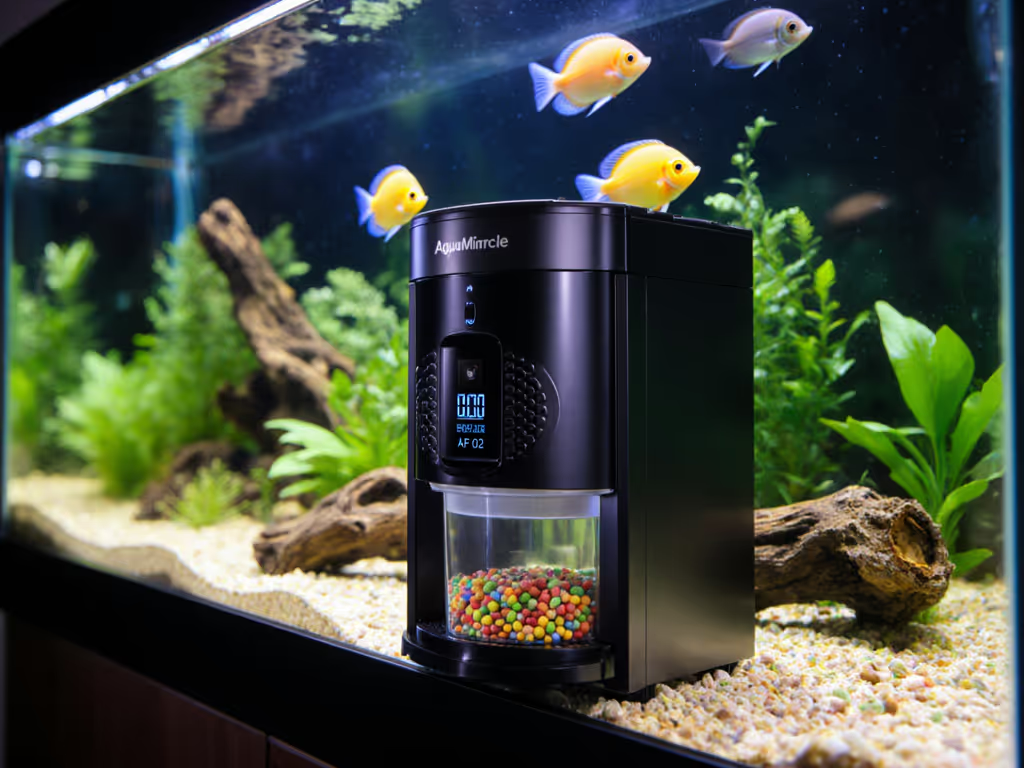
The F14 employs a rotating drum design with 14 individual compartments, each capable of holding a separate meal portion. A quartz timer controls the rotation, advancing to the next compartment at your specified feeding intervals. The device delivers food gradually over approximately two hours per feeding cycle, which moderates water column disruption and prevents the sudden ammonia spike associated with dump feeding. This slow-release approach aligns with published feeding science: frequent, small meals are metabolically superior to fewer large ones.
Physical Design and Mounting
The unit measures 139mm × 118mm × 39mm (roughly 5.5" × 4.6" × 1.5"), making it compact enough for most hood-mounted applications. It ships with mounting brackets suited for standard glass canopies or tank edges, though some users report mounting on a canopy cutout works equally well. The moisture-resistant hopper resists humidity buildup, a critical detail for feeders exposed to aquarium splash and ambient moisture.
Dial Logic and Peg Insertion
Here's where hands-on testing reveals friction points. Setup requires inserting plastic pegs into a timer knob to specify feeding times (up to four feedings per day maximum). The mechanism functions intuitively once understood, but initial configuration isn't self-explanatory. If setup feels unclear, follow our step-by-step feeder calibration guide to dial in timing and portions. Reviewers report the pegs are slightly fiddly to position, and the visual indicator on the dial requires careful alignment. How does this live day to day? After setup, it runs predictably, but if you need to adjust schedules, you'll be reorienting pegs repeatedly.
Real-World Performance: Reliability and Consistency
Across documented user reports and technical reviews, the F14 demonstrates solid operational reliability. One YouTube reviewer noted it "has always been very reliable...it goes off when it's supposed to go off." A Chewy customer confirmed: "I tested this before our trip and it fed on time three times a day as scheduled." Vacation testimonials stand out: multiple users report successful 14 to 15 day trips with both goldfish and bettas, suggesting the 14-meal capacity genuinely extends coverage for moderate feeding schedules.
Battery performance aligns with manufacturer claims. A single AA alkaline battery delivers approximately 12 months of continuous operation, eliminating the hassle of frequent replacements. For users who remove the battery during extended downtime (a best practice), longevity stretches further.
Portion Control Precision
One specific strength: the compartmentalized design enables granular control over feeding amounts. Unlike drum feeders with a single hopper and variable output, the F14 lets you load different quantities into each compartment. This is particularly valuable for users managing fish with varying daily intake requirements or those working within strict bioload constraints. You pre-portion food, test the mechanism, and know exactly what will be delivered each cycle.
However, this advantage carries a maintenance trade-off. Preparing 14 compartments requires more setup time than filling a single hopper on other designs. If you adjust feeding schedules or fish populations frequently, this becomes a regular workflow task.
Limitations: Where Practical Reality Emerges
Food Type Compatibility Issues
The F14 handles pellets well, particularly larger sizes (1-2mm diameter and above). Smaller pellets and flake food present documented problems. Fine flakes grind within the rotating drum, creating dust that accumulates internally and degrades mechanism smoothness. Similarly, tiny fry food can jam against the compartment ledges during rotation. Reef hobbyists accustomed to small-pellet formulations may find this incompatible. If flakes or micro-pellets are your staple, check our feeders by food type comparison for better-matched options.
Refill Frequency
With 14 compartments total, the feeder accommodates a limited feeding cycle. Use our feeder capacity guide to estimate refill intervals for your tank and schedule. If your protocol demands four feedings daily, the F14 lasts only 3.5 days before refilling. This constraint pushes the device toward single or double-feeding schedules, or requires commitment to a rigorous refill routine on short intervals. For someone seeking "set and forget" vacation feeding, this works fine. For daily automation of intensive schedules, it becomes a regular maintenance task.
Dispersion Pattern Inconsistency
Some reviewers noted the food dispenses gradually over ~2 hours, but not always as discrete portions at the stated time. The trickle pattern is intentional (preventing water quality shock), yet the timing predictability occasionally drifts. This matters less for vacation use and more for those trying to synchronize feedings with lighting cycles or monitoring when fish actively consume.
Maintenance Workflows and Serviceability
This is where a simple core philosophy proves essential: the right feeder is one you can maintain correctly every time. The F14 requires realistic assessment here.
Regular Maintenance Tasks
Compartment cleaning: After each refill cycle, dust from flake food or pellet breakage should be cleared. This is a 2-3 minute task, wipe compartments with a soft, dry cloth to prevent dust from accumulating in the mechanism. For long-term care, follow our feeder deep clean guide to prevent buildup and extend lifespan.
Peg repositioning: Adjusting feeding times means removing and reinserting pegs. The plastic components tolerate repeated handling, but mechanical friction gradually loosens the fit over months. This isn't a catastrophic failure mode, but it's a degradation path.
Battery replacement: Simple and intuitive, a single AA swap. No specialized tools required.
Spare Parts Availability
Search findings indicate replacement peg sets are sold separately, suggesting component-level serviceability. However, availability through mainstream retailers appears inconsistent compared to larger feeder brands. If a rotor or main mechanism component fails outside warranty, repair options may require direct manufacturer contact.
Scenario-Based Assessment: Where the F14 Excels
- Small tank keepers (10-40 gallons): The compact size and modest capacity suit limited bioloads. A single or double daily feeding schedule uses the full 14-compartment cycle over a full week.
- Vacation coverage: For planned absences of 7-14 days, the F14 delivers documented reliability. Pre-portion food, set timing pegs, confirm mechanism movement before departure, and depart with justified confidence.
- Fry rearing and specialized protocols: The slow rotational mechanism enables frequent small portions essential for fry development or species requiring multiple daily feedings in measured amounts. This niche capability sets it apart from simpler designs.
- Budget-conscious hobbyists: At a lower price point than many competitors, the F14 offers functional automation without premium-tier pricing.
- Tanks using large pellets or consistent diet: Fish consuming 1-2mm or larger pellets, or those on single-food protocols, experience fewer compatibility issues.
When the F14 Falls Short
- High-intensity feeding protocols: If your routine demands four feedings daily, the 14-compartment capacity forces refills every 3.5 days, negating the "set and forget" advantage.
- Flake-based diets: Fine food particulates degrade the internal mechanism over time. Dedicated flake feeders, or manual feeding for flake enthusiasts, sidestep this weakness.
- Frequent schedule adjustments: Households with changing routines or multiple people managing the feeder will repeatedly re-peg the dial. More streamlined UI designs (digital timers with button interfaces) reduce this friction.
- Reef-specific fine pellets: Many reef formulations use sub-1mm pellets designed for specific gravity and nutrient density. These often jam or scatter inconsistently through the F14's mechanism.
The Maintenance Reality Check
From personal testing experience, the reliability of any feeder ultimately depends on pre-departure validation. Before a two-week trip, I tested three feeders on my reef and a brackish tank. Only the unit with a locking hopper, gasketed drum, and clear UI survived humidity and fat pellets. That taught me that theoretical specifications diverge sharply from actual performance under travel conditions. The F14 incorporates a gasketed hopper design resisting moisture, a positive sign. Its manual peg system, however, lacks the locking mechanism that prevents accidental rotation. Test yours thoroughly before extended absence, loading it with your actual food type and running full cycles while observing.
Cost-Benefit Positioning
The F14 occupies the value tier of automatic feeders, significantly cheaper than programmable digital models or high-capacity hoppers, yet more reliable than the cheapest rotary knockoffs. For the investment level, it delivers credible mechanical execution. That said, the lower price reflects genuine trade-offs: limited capacity, food-type compatibility limitations, and a manual peg interface rather than digital programming.
Summary and Final Verdict
The Fish Mate F14 is a pragmatic, scenario-focused automatic feeder best suited to small-tank hobbyists managing 7-14 day absences or those requiring granular portion control across multiple feedings. Its rotary drum mechanism is genuinely reliable when properly maintained, its compartmentalized design enables precision feeding, and its battery longevity sidesteps the nuisance of frequent replacements.
Where the F14 falters: high-frequency feeding schedules will exhaust the 14-meal capacity quickly, flake-food users will confront internal dust accumulation, and those seeking digital convenience will find the manual peg system tedious. The design philosophy prioritizes mechanical simplicity and cost efficiency, which yields reliability within its defined scope but constrains flexibility.
The verdict: Buy once, maintain easily, and sleep well on travel days, but only if your feeding protocol, food types, and tank size align with the F14's capabilities. This feeder doesn't adapt to demanding or variable workflows. It executes a narrow, well-defined job competently: delivering consistent, modest portions on a predictable schedule for small systems. Test it with your actual food and feeding routine before commitment. If your requirements fit its constraints, it's a trustworthy, affordable solution. If your schedule or diet demands exceed its design parameters, the maintenance burden and performance gaps will eventually frustrate.
For the conscientious hobbyist seeking reliability over features, the F14 represents honest engineering, nothing more, nothing less.
Related Articles