Seahorse Feeder Comparison: Micro-Portion Metrics
By Arjun Mehta • 8th Apr
Seahorse feeder comparison demands a fundamentally different mindset than most aquarium feeders. These delicate syngnathids (seahorses) are not goldfish. For behavior-driven context, read our species-specific feeding guide. They don't inhale pellets. They're ambush predators with tubular mouths designed to siphon small crustaceans in natural current seams, and feeding them requires reimagining what "precision" means in an automated system. Unlike conventional fish feeders that dispense volume, seahorse feeding demands micro-portion metrics, feed redundancy, and fail-safe delivery mechanisms.
Years ago, I learned this the hard way. An early auto-feeder I trusted failed catastrophically: stuck valve, entire weekend ration dumped at once, and an ammonia spike that crashed the tank within 36 hours. The recovery took months. Since then, every feeding system I design includes clog detection, redundant timers, and daily micro-dosing over weekend macro-blunders. That philosophy governs this guide: Feed like a system, never a hopeful guess.
Let's examine how different feeder approaches (and feeding methodologies) actually perform under pressure.
Why Standard Auto-Feeders Don't Work for Seahorses
Can I use a conventional automatic feeder?
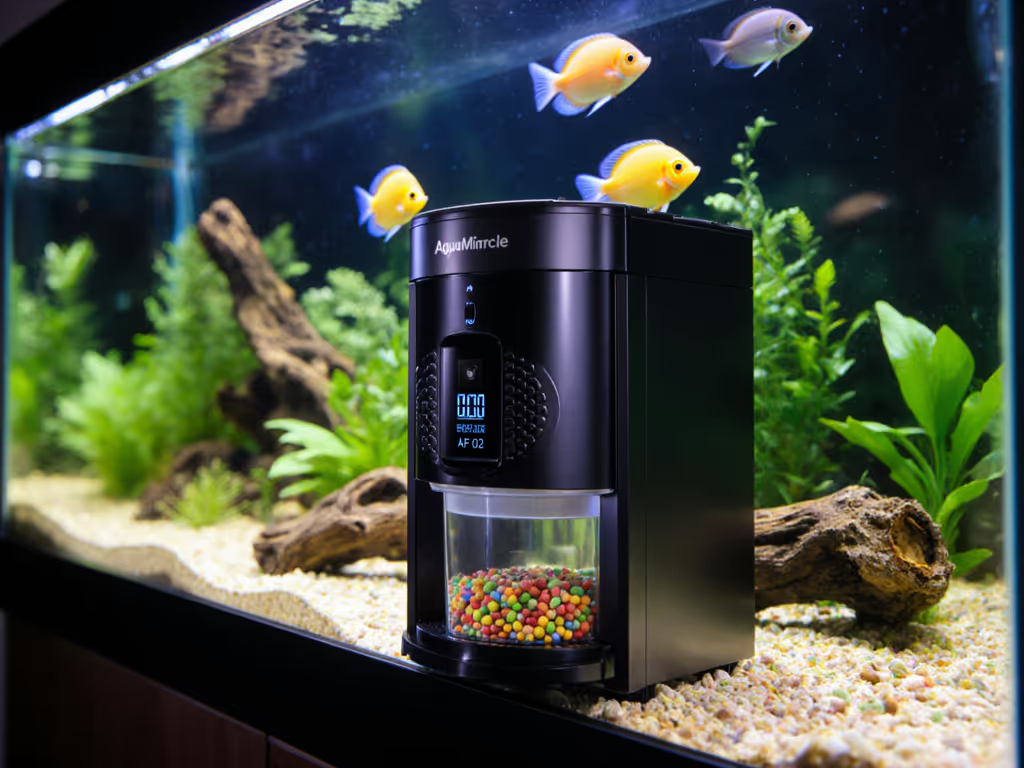
No. Seahorses require either frozen food or live foods on a daily basis, and conventional auto-feeders are fundamentally incompatible with this requirement. Standard pellet-based dispensers are designed for fish that accept dry food and can handle variable particle sizes. Seahorses do not. Captive-bred seahorses are weaned almost exclusively onto frozen Mysis shrimp (specifically enriched varieties) and will often refuse alternative foods entirely once imprinted. If you need an automated frozen-food solution, see our aF4 frozen feeder review. An auto-feeder dumping pellets into a seahorse tank accomplishes nothing except waste and water-quality degradation.
More critically, there's a failure mode asymmetry at play. When a conventional feeder jams, it either dispenses nothing or everything. With seahorses, everything is the catastrophic scenario. A single miscalibration or stuck valve can dump a 2-day ration into a confined system, spiking ammonia before you even notice.
What makes seahorse feeding unique?
Syngnathid feeding behavior is fundamentally different from that of most aquarium fish. Seahorses are slow ambush predators with limited swimming ability, a design constraint reflected in their 30-150 micron snout diameter and suction-feeding mechanics. They cannot chase food. They cannot process oversized particles. They cannot tolerate the chaotic feeding frenzies that most fish tanks depend on.
Captive-bred seahorses are completely weaned onto frozen Mysis shrimp, with a nutritional baseline of 90-95% Mysis in their diet. That's not preference: that's metabolic dependency. Deviation costs visibility, immune response, and breeding readiness. Most importantly, seahorses cannot regulate their own intake the way goldfish do. They will gorge if food is continuously available, leading to digestive stress and water-column fouling.
Feeder Types: What the Data Show
Manual Hand-Feeding (The Baseline)
Metric: Portion control, consistency, feed waste.
Manual feeding (typically 1-3 times daily, 2-4 Mysis per seahorse per feeding) remains the gold standard for portion precision. No hardware failure, no jams, no miscalibration. You observe consumption in real-time, adjust portions based on appetite, and pull uneaten food within 3-5 minutes. Water chemistry stays stable because overage is physically impossible.
Failure modes: Human error (over-generosity), missed feedings during travel, inconsistent timing (which seahorses notice), labor intensity.
Best practice: Establish a schematic feeding log. Track date, time, portion size (e.g., "2 Mysis per seahorse"), consumption time, and any behavioral anomalies. After two weeks, you'll have a dataset that reveals your seahorse's true intake needs.
Feeding Trays and Slow-Drift Systems (The Precision Approach)
Metric: Micro-drift rate, settling depth, portion longevity.
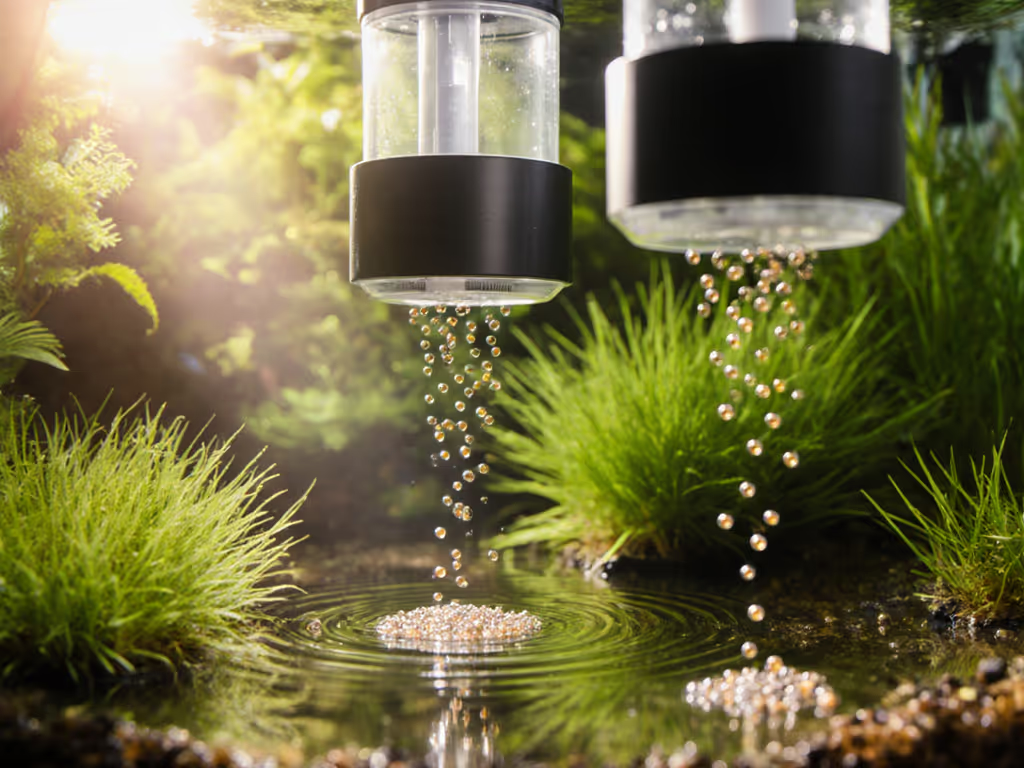
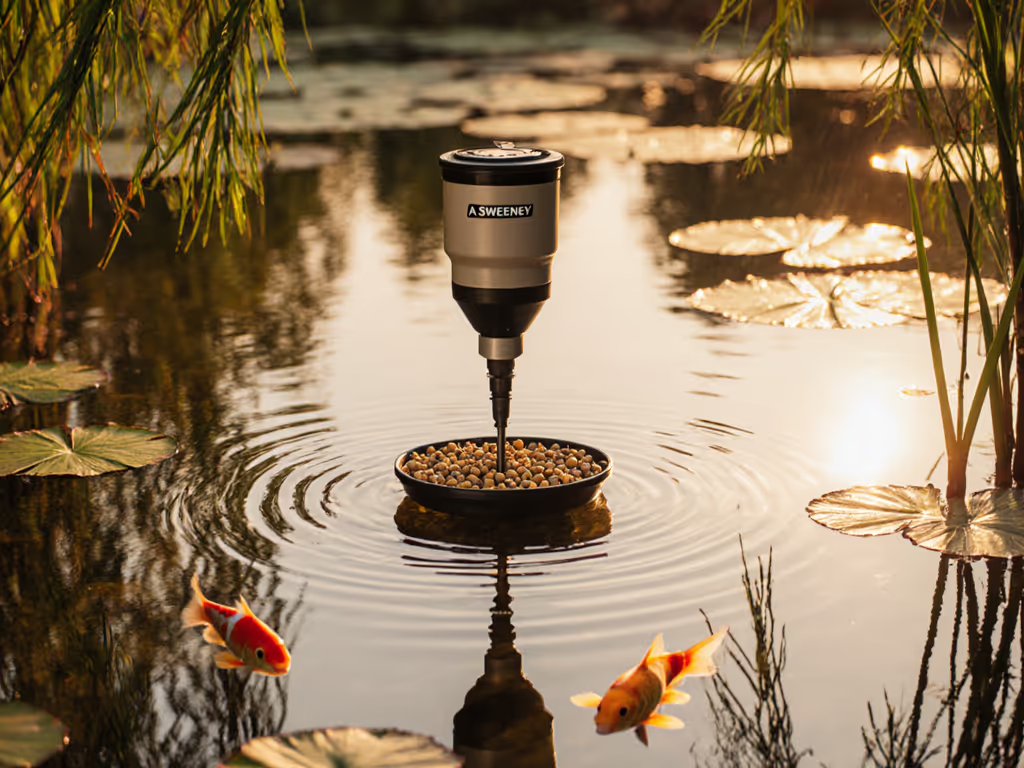
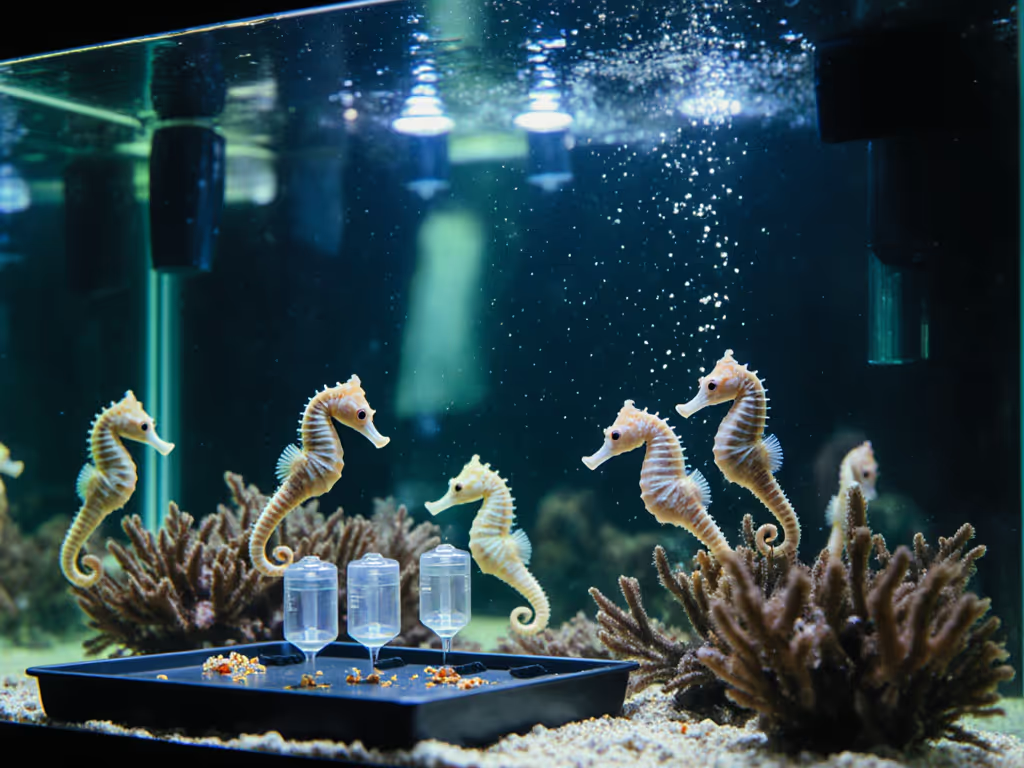
Slow-drift feeding systems (typically acrylic trays or tube-based delivery) work by controlled descent. Enriched frozen Mysis is fed into the top of a thin siphon tube; as it thaws, it descends slowly to a feeding station (tray or dish) 12-18 inches below. Seahorses track the food's descent and intercept it mid-water, mimicking their natural behavior of plucking prey from water column structures.
This method decouples portion control from delivery timing. You place a specific amount in the tube (say, 5 Mysis), and the system ensures 100% consumption within a known window (typically 3-8 minutes). Drift rate is adjustable by tube diameter and angle. Smaller tubes = slower descent = better sensory cue for seahorses.
Critical measurement: Micro-drift rate. Most effective systems deliver food at 1-3 inches per second, fast enough to trigger strike behavior, slow enough that seahorses don't panic. Faster descent rates (>4 in/sec) often cause missed feeding attempts; slower rates (<0.5 in/sec) risk food settling and rotting.
Failure modes: Tube clogging (frozen food partially thawed before feeding), algae buildup reducing transparency, drift rate inconsistency due to temperature fluctuations, improper tray positioning causing uneaten food to escape the feeding zone.
Risk mitigation: Use dedicated acrylic seahorse feeding trays with 4"×2.5"×1" internal dimensions, small enough to contain micro-portions but large enough to prevent crowding stress. Position the tray in a low-flow zone to prevent food washout. Use a tube diameter of 0.5-0.75 inches to minimize clogging while maintaining controllable descent.
Live Food Feeder Systems (The Ecosystem Approach)
Metric: Nutritional sustainability, self-maintenance, feed-and-forget viability.
Live food feeders (typically enclosures containing red feeder shrimp (Halocaridina rubra) or enriched brine cultures) represent a middle path: they sustain themselves in saltwater, require minimal daily intervention, and provide continuous nutritional availability without the metabolic "dump" risk of automated dispensing. Compare practical options in our live food feeder tests.
Halocaridina rubra shrimp are particularly well suited for this application. They:
- Thrive in full-strength saltwater indefinitely
- Feed on algal mats and bacteria (no separate cultivation needed)
- Remain bite-sized (3-5 mm) for seahorse consumption
- Are nutritionally rich, especially when gut-loaded with Spirulina or specialized enrichment
- Self-regulate population under seahorse predation pressure
Metric-driven advantage: A live feeder culture eliminates dispensing error entirely. Seahorses graze naturally from the culture at self-determined intervals, never overdosing, never starving. Water parameters in the main tank remain stable because live prey is consumed at metabolic rate rather than bolus delivery rate.
Critical limitation: Live feeders work only as supplementary nutrition (5-10% of intake), not primary diet. Most captive-bred seahorses still require daily Mysis supplementation because live cultures cannot deliver the 90%+ Mysis baseline these fish depend on. Live feeders reduce, not eliminate, manual feeding labor.
Failure modes: Culture crash (bacterial bloom, temperature swing), insufficient population density, seahorse predation exceeding reproduction rate, poor water exchange allowing organics to accumulate.
Redundancy and Risk-Aware Feeder Design
Why single-point systems fail
Conventional aquarium automation assumes that if Device A fails, you're simply without that feature. For seahorses, failure asymmetry inverts that equation: a single stuck or miscalibrated feeder doesn't just remove feeding, it catastrophically degrades water chemistry. One weekend is enough to crash your system.
The only defensible design uses dual-layer redundancy:
- Primary layer: Automated timed delivery (e.g., multi-portion feeding tray with manual trigger, or refrigerated live feeder)
- Secondary layer: Manual hand-feeding as a safety net, performed daily regardless of primary system state
If the primary system jams, sticks, or miscalibrates, secondary feeding ensures your seahorses eat and your tank doesn't spike ammonia. If the secondary layer is neglected (human error), the primary system catches the miss. Together, they form a risk-mitigated feeding protocol, not a gamble.
Metric-driven monitoring: What to track
Establish a feeding schematic with these measurable parameters: For the biology behind these metrics, see our science-backed feeding and water quality guide.
- Portion size: Fixed quantity (e.g., "3 Mysis per seahorse per feeding"), not estimate
- Consumption time: Duration from delivery to total ingestion (target: 2-5 minutes)
- Frequency: Fixed intervals (e.g., 08:00 UTC, 17:00 UTC, 22:00 UTC)
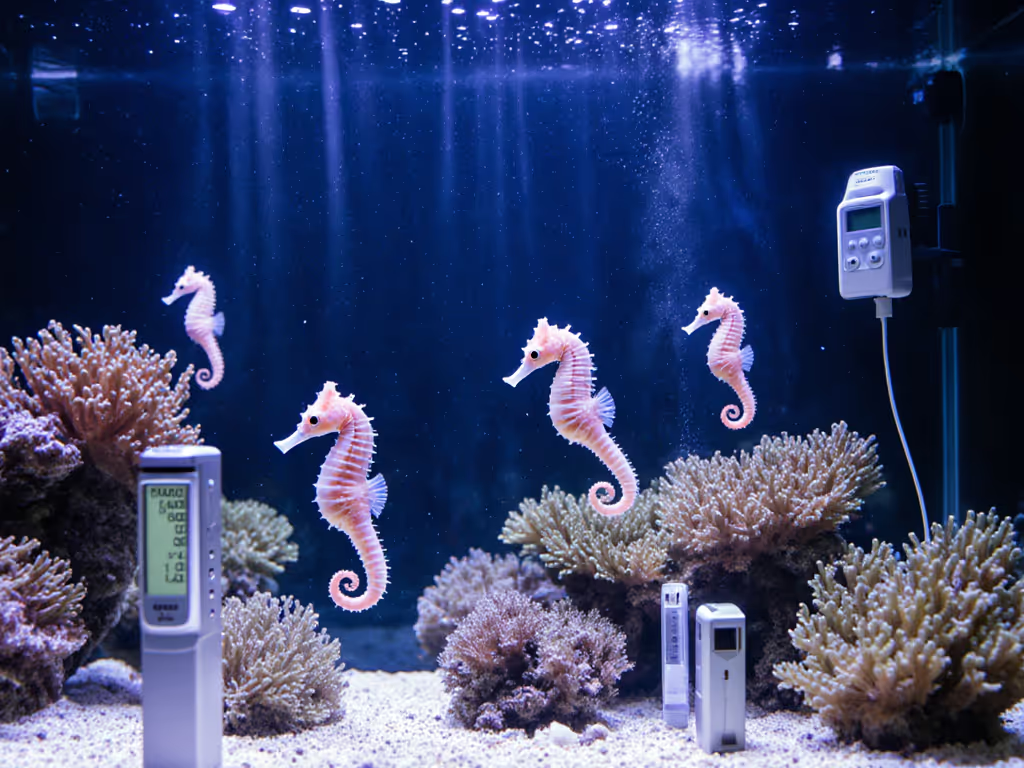
- Ammonia/nitrite baseline: Weekly test strip at 24 hours post-feeding; sudden deviation signals over-feeding
- Visual appetite cues: Snout orientation, feeding response time, color intensity (appetite correlates with coloration)
Data from 4-6 weeks of logging reveals your system's true efficiency. You'll see whether your seahorse actually needs a 3rd daily feeding, whether your portion size is calibrated correctly, and whether your feeder (manual or mechanical) is operating within acceptable variance.
Delicate Species Portion Control: The Numbers
Captive-bred seahorses (Hippocampus erectus, H. reidi, H. kuda) require approximately 2-4 frozen Mysis shrimp per feeding, 2-3 times daily. That's roughly 6-12 Mysis per day per individual seahorse. Dwarf seahorses (H. zosterae) require proportionally less (1-2 Mysis per feeding).
The variance exists because individual metabolic rate, age, and tank temperature all affect intake. A 3-year-old seahorse in a 76°F tank has different caloric needs than a 1-year-old in 72°F. Rather than prescribing fixed intake, establish your seahorse's baseline through observation:
- Offer 3 Mysis at first feeding
- Observe consumption time (note duration and behavior)
- Count any remainder after 5 minutes
- Adjust portion by ±1 Mysis based on consumption pattern
- Repeat daily for two weeks, logging all data
Within 14 days, you'll converge on a portion size that results in 95%+ consumption and zero left-over decay. That's your calibrated micro-portion baseline.
Enrichment and nutritional redundancy
Mysis shrimp alone, while nutritionally complete, benefit from supplemental enrichment, particularly HUFAs (highly unsaturated fatty acids) and long-chain fatty acids. These compounds support immune response, coloration, and reproductive vigor. Most captive-bred seahorses benefit from periodic (2-3 times weekly) diversification:
- Enriched frozen brine shrimp (Hikari Spirulina, San Francisco Bay enriched varieties) - not as primary diet, but rotation reduces monotony
- Pacific plankton or amphipods - nutritional variety without metabolism risk
- Live brine shrimp (enriched 24 hours pre-feeding) is an acceptable supplementary option
The principle: 90-95% Mysis baseline + 5-10% nutritional rotation = metabolic health without experimentation risk.
Practical Feeder Setup: Installation and Verification
Slow-drift tube assembly
If choosing tube-based delivery: For placement strategies that preserve stability, use our feeder placement metrics.
- Tube selection: 0.5-0.75" acrylic or vinyl tubing, clear (transparency confirms flow), smooth interior (clog resistance)
- Angle: 45-60° descent from horizontal (steeper = faster, gentler = slower drift)
- Tray positioning: Acrylic seahorse tray or clam shell, centered in low-flow zone, 12-18" below tube exit
- Thermal buffering: Pre-thaw Mysis to ~65°F (not full thaw, not frozen solid) before feeding to prevent thermal shock and reduce descent-rate variance
- Verification: Conduct a dry-run test with a food-dye droplet; confirm 2-5 seconds per inch of tubing
Live feeder enclosure setup
- Breeder box or isolation chamber: 5-10 L capacity, placed within the main tank or connected via air line to maintain salinity parity
- Feeding substrate: Algae-encrusted live rock or macro algae (provides nutrition and refuge for feeder shrimp)
- Partial water exchange: 25-50% exchange weekly, using main tank water to prevent parameter drift
- Population monitoring: Count visible shrimp population weekly; if declining >50% month-over-month, increase algae surface or reduce seahorse predation pressure
Daily verification checklist
- ✓ Primary feeder operational (tube clear, tray positioned, drift rate verified)
- ✓ Secondary manual feeding completed (portion size logged, consumption observed)
- ✓ Uneaten food removed within 5 minutes
- ✓ Water parameters stable (ammonia <0.5 ppm, check when tank temp >78°F or feeding volume exceeds baseline)
- ✓ Seahorse appetite and color normal (subjective, but any deviation warrants investigation)
Summary and Final Verdict
Seahorse feeder comparison reveals a hard truth: there is no universally "best" feeder because seahorse feeding is not primarily about the equipment; it is about the system.
Manual hand-feeding with a data-logged feeding schematic remains the safest baseline. It eliminates hardware failure, guarantees portion precision, and provides real-time appetite monitoring. If you're committed to seahorse health, this is not compromise; it's the foundation.
For those seeking operational efficiency, slow-drift feeding trays represent the next tier of precision: controlled descent, reproducible consumption windows, minimal hardware complexity. Risk-aware aquarists pair this with daily secondary hand-feeding, creating redundancy that defends against both mechanical and human error.
Live feeder cultures supplement but never replace primary Mysis feeding. They provide behavioral enrichment and nutritional diversity, but they cannot sustain the 90%+ Mysis baseline that captive-bred seahorses metabolically require.
The metric that matters most is this: Can your system fail without spiking ammonia and crashing your tank? If the answer is "only if I hand-feed as backup," then you have a defensible design. If the answer is "it depends on one automated device," then you're gambling. Feed like a system, never a hopeful guess.
Establish a feeding log. Track portions, consumption time, water parameters, and behavioral cues. Iterate weekly based on data. Within 4-6 weeks, you'll own a calibrated, risk-mitigated feeding protocol that keeps your seahorses thriving and your water chemistry stable. That's not fancy. It's precision.
Related Articles